
Collective Memory
and understanding the effects of my Grandmother's passing

Listening to: Dust in the Wind by Kansas
I recently read an article on Memory Studies in preparation for a final exam I had in my Art Historical Methodologies class. The article was from 1950 written by a man named Maurice Halbwachs titled “The Collective Memory.” The conversation on Collective Memory is still a tricky topic for me to fully understand. The article itself didn’t do a lot to help as it was filled with general psychological ideas that were meant to be applied to group dynamics. For the exam we had to read Chapter 4 “Space and the Collective Memory” with the first subheading being “The Group in Its Spatial Framework: The Influence of the Physical Surroundings.” It discussed the relationship between the group (and it can be any group but he uses a household as the example) and how the space that surrounds the group affects the dynamics of the group. Collective memory is essentially what the name entails, it is how a group of people remember situations that they were all a part of. But a better definition from the National Library of Medicine says, “Collective memory refers to the memories that individuals have as members of the groups to which they belong, whether small (family, school) or large (political party, nation).” The analogy of the house is easiest to apply because the collective memory of getting a new puppy, smashing the good china, or the burning the Thanksgiving turkey can all be remembered differently by the individual in the group.
In discussing the relationship between the group and the space, Halbwachs mentions how certain situations can affect the dynamic of the group. He was able to articulate a moment I had that is universally experienced, but unique to the individual. And the fact that such a succinct explanation gave me a revelation that hit me 5,000 miles away from home, almost two years later, allows me to appreciate the profound nature of literature. I feel connected to Halbwachs, I feel more connected to the moment, and even more connected with the accepting change. He wrote,
“The same is true for disturbances in smaller groups based on blood, friendship, or love when death, disagreements, or the play of passion and interest intervene. Under the shock of such troubles, we walk the streets and we are surprised to find life going on about as if nothing had happened. Joyful faces appear at windows, peasants converse at the crossroads, buyers and sellers stand on ship steps, while we, our family, our friends, experience the hurricane of catastrophe.”
My mind could not help but go back to the day my heart broke at the news of my grandmother passing. Halbwachs’ words caused me to relive one particular moment, from that long day.
As we were notified of the hearse’s arrival to come to receive my grandmother we each said our final goodbyes as she laid there peacefully in her bed. The walls seemed narrower, the wooden panels felt darker, and the house was eerily quiet safe for the shuffling of feet as people moved about. My mother was behind me as I pulled the screen door of my granny’s house open to step out to the drive way. My father had his back to us and I could tell by the way he was looking up to the sky that he was trying not to cry. He had his lips rolled into his mouth as if that was to be the dam to stop the flood of tears. As strong as my father has always been, the weight of this loss crumbles even the best of our resolve. I hugged him on the right and my mother went around and hugged him on his left. We stood there in each other’s arms long enough for the men to have loaded my grandmother onto the stretcher and out the front door. We watched as they put her in the back of the hearse and I understood that this was not just my grandmother I was watching, but my father watching his mother. In what world would I ever be strong enough to watch my mother get wheeled away one day? I looked over to my own mother and thought about how I could not possibly go through this feeling again. Then I looked out into the world and the neighborhood and street my grandmother’s house was on and thought about what was happening in their houses. I thought about how their life was going on as normal. My grandmother was gone and life was still moving without her. What would the neighbors see on a random day for them and the worst day of mine, if they peaked outside right now? They would see us huddled together, black hearse gleaming in the sun as it pulled away. A world that felt so blue.
It wasn’t until later I understood W.H. Auden’s “Funeral Blues” that everything indeed needed to stop, and it had. Time was suspended in the ether and I felt unable to move from the minute my father came to get me from my job to break the news. How could this street be the same with my grandmother no longer on it? Halbwachs said, “we, and those whom we hold dear, constitute only a few units in this multitude.” And oh how I understood the multitude in the moment. With my father wrapping me in his arms, and me holding on to my mother’s as she wrapped her arms around him I understood how little we were and how big the world was, and that it all just became a little bit smaller and a lot dimmer without my grandmother’s light.
In loving memory February 23, 2024.
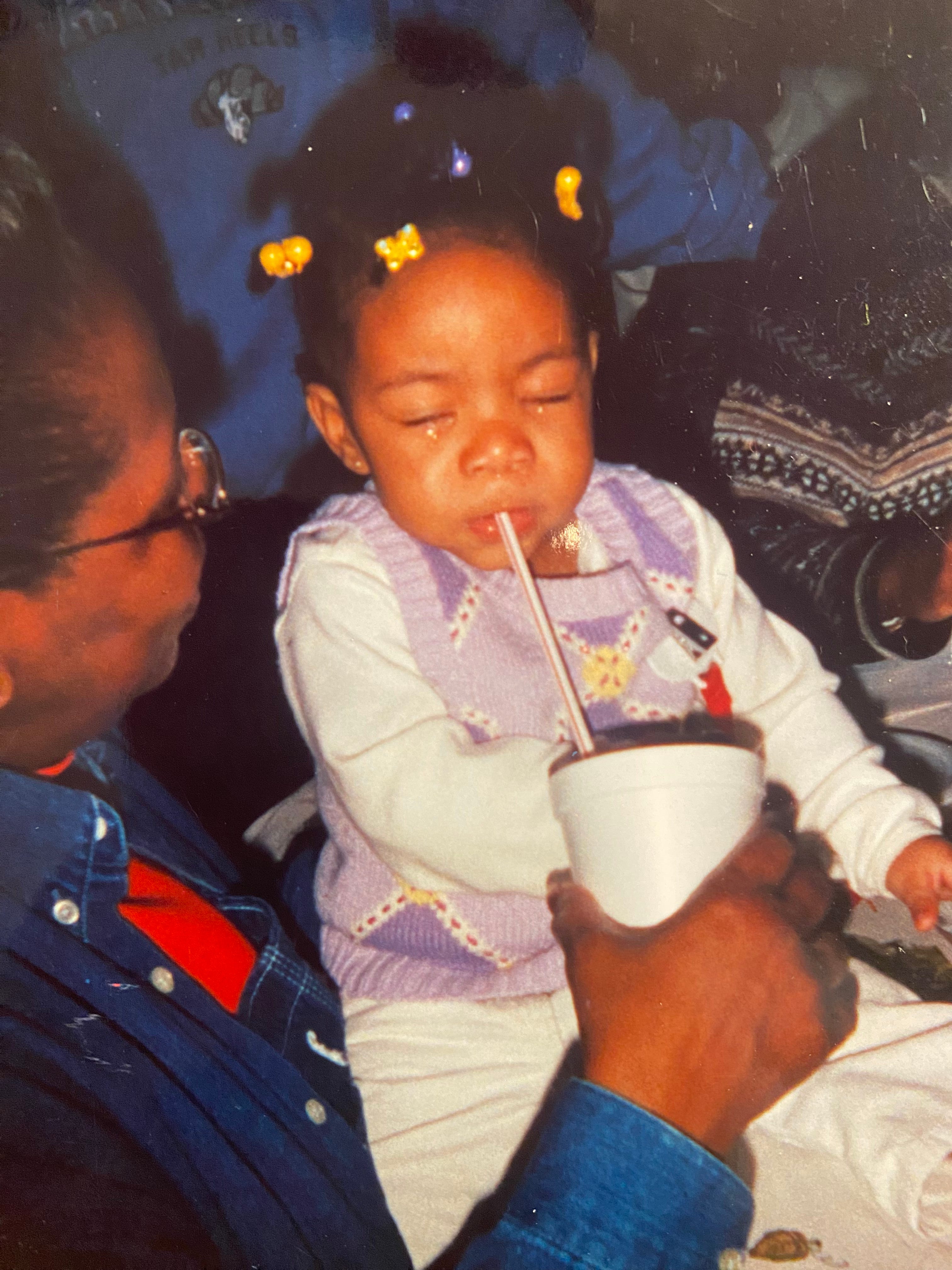
The article on Collective Memory we read for class:
Halbwachs, M. The Collective Memory. Massachusetts Institute of Technology. 1950 https://web.mit.edu/allanmc/www/hawlbachsspace.pdf
More on the definition of Collective Memory:
Roediger H. L. (2021). Three facets of collective memory. The American psychologist, 76(9), 1388–1400. https://doi.org/10.1037/amp0000938